
YouTube Money Calculator – Estimate Your Channel Earnings
How Much Does 100K Views Pay on YouTube?
There is no single number. 100,000 views typically pays between $200 and $3,000, and where you land depends almost entirely on your niche. A finance channel and a gaming channel can post the same view count in the same month and see a tenfold difference in the payout.
The number that decides it is RPM — what you actually earn per 1,000 views after YouTube takes its 45% share. Advertisers bid far more to reach someone researching a mortgage than someone watching a gameplay clip, and that gap flows straight through to you.
| Niche | Typical RPM | 100K views pays |
|---|---|---|
| Personal finance, investing, insurance | $12–$30 | $1,200–$3,000 |
| Business, marketing, B2B software | $10–$22 | $1,000–$2,200 |
| Tech reviews, software tutorials | $6–$14 | $600–$1,400 |
| Health, fitness, nutrition | $5–$12 | $500–$1,200 |
| Education, study, careers | $4–$10 | $400–$1,000 |
| Travel | $4–$9 | $400–$900 |
| Food and cooking | $3–$8 | $300–$800 |
| Gaming | $2–$6 | $200–$600 |
| Vlogs, entertainment, reactions | $2–$5 | $200–$500 |
| Shorts (any niche) | $0.05–$0.15 | $5–$15 |
Two things move you within these ranges more than anything else. Audience country: views from the United States, Canada, Australia and the UK pay several times more than views from low-CPM regions, so a channel with 70% US traffic will sit near the top of its band. Video length: videos over eight minutes allow mid-roll ads, which can lift RPM by 30–50%.
Also worth knowing: ad revenue is rarely the biggest line for established channels. Sponsorships, affiliate links, and your own products routinely out-earn AdSense at the same view count. Use the calculator above to run your real numbers.
YouTube Money Calculator: How Much Do YouTubers Really Earn?
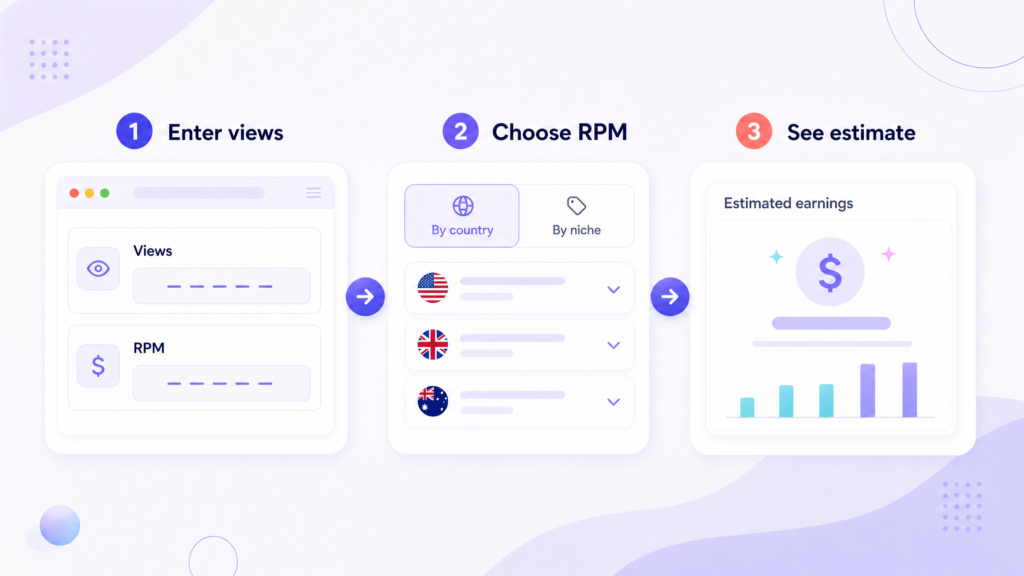
This free YouTube money calculator estimates how much a channel earns from ads based on daily views and RPM (revenue per 1,000 views). Enter your average daily views, pick your niche, and the calculator instantly shows estimated daily, monthly, and yearly AdSense earnings. It works for long-form channels, and includes a preset for YouTube Shorts, which pay dramatically less per view.
How YouTube Earnings Are Calculated
YouTube pays creators through the YouTube Partner Program. Advertisers pay YouTube based on CPM (cost per 1,000 ad impressions), YouTube keeps 45% of long-form ad revenue, and the creator receives the remaining 55%. RPM is the number that matters to you as a creator: it is your actual revenue per 1,000 video views, after YouTube's cut, averaged across all views — including views that showed no ad at all. That is why this calculator uses RPM directly: it reflects what actually lands in your AdSense account, not the inflated CPM figures often quoted online.
Typical RPM by Niche
RPM varies enormously depending on what your channel is about, because advertisers pay more to reach certain audiences. Finance and investing channels sit at the very top, around $12–$30 RPM, because banks, brokers, and fintech companies bid aggressively for those viewers. Business and marketing content follows at roughly $10–$22, then tech reviews at $6–$14 and health and fitness at $5–$12. Education lands around $4–$10, travel around $4–$9, and food and cooking around $3–$8. Gaming typically runs $2–$6 thanks to a younger audience, and general entertainment, vlogs, and music sit at $2–$5. YouTube Shorts operate on a separate revenue pool and typically pay only $0.05–$0.15 per 1,000 views, which is why Shorts views alone rarely generate meaningful income.
Why Audience Country Matters So Much
Two channels with identical views can earn wildly different amounts. Advertisers pay far more to reach viewers in the United States, Canada, the United Kingdom, and Australia than viewers in most other regions. A channel with a majority-US audience can earn several times more than the same channel with the same content viewed mostly from lower-CPM countries. This is why many creators produce English-language content aimed at Western audiences: the same effort simply pays more. Seasonality matters too — RPM typically peaks in Q4 (October–December) when advertisers spend holiday budgets, and dips in January.
Beyond AdSense: The Full Earnings Picture
Ad revenue is usually just the starting point. Established creators typically earn more from sponsorships (often $10–$50 per 1,000 views for a dedicated integration), affiliate links, channel memberships, and their own products than from ads. If your calculated AdSense number looks small, remember that a channel with even 50,000 monthly views has real leverage for affiliate and sponsorship income that this calculator does not include.
Frequently Asked Questions
How much does YouTube pay per 1,000 views? Typically $2–$6 for entertainment and gaming channels, $4–$14 for education and tech, and $12–$30 for finance — with Shorts at roughly $0.05–$0.15.
How many views do I need to earn $1,000 per month? At a $3.50 RPM, about 286,000 views per month (roughly 9,400 per day). At a $21 RPM finance channel, under 50,000 monthly views.
What are the requirements to monetize a channel? The YouTube Partner Program requires 1,000 subscribers plus either 4,000 public watch hours in the past 12 months or 10 million Shorts views in the past 90 days.
Is RPM the same as CPM? No. CPM is what advertisers pay per 1,000 ad impressions before YouTube's cut. RPM is what you actually receive per 1,000 video views — it is always lower than CPM, and it is the honest number to use for income estimates.