House Affordability Calculator
| Principal & interest | $1,759 |
| Property tax | $310 |
| Home insurance | $125 |
| PMI | $139 |
| Total monthly | $2,333 |
How Much House Can I Afford?
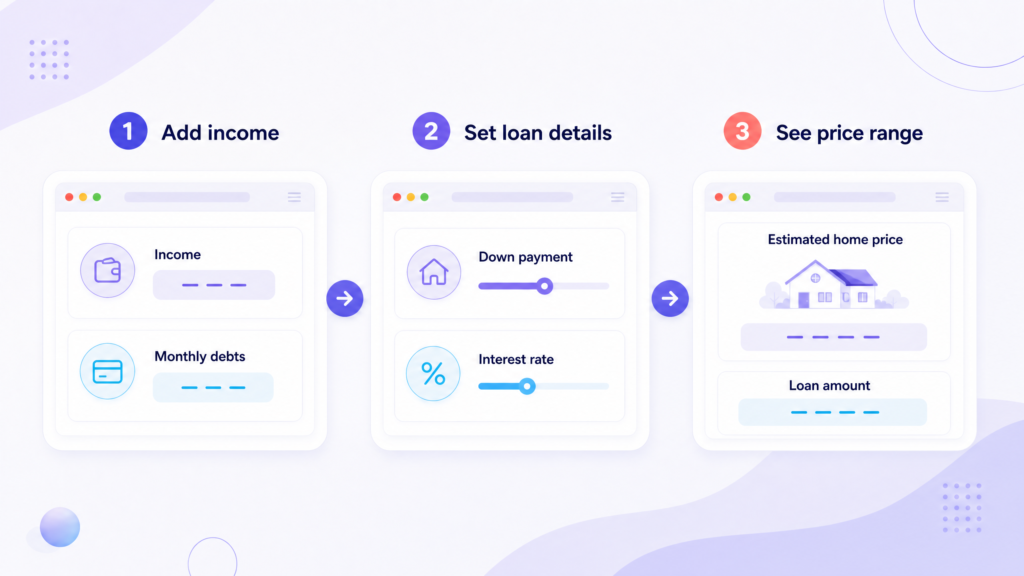
Most affordability calculators only apply the 28% rule and stop there. This one also applies the 36% total-debt limit, adds property tax, insurance and PMI, and tells you which of the two limits is actually holding you back — because that determines what you should do about it.
The two rules lenders use
The 28% rule. Your total housing payment — principal, interest, tax and insurance — should stay at or below 28% of gross monthly income.
The 36% rule. All your debt payments combined, housing included, should stay under 36% of gross income.
Whichever gives the smaller number is the one that binds. For someone with no other debt, it is almost always the 28% rule. Add a car payment and a student loan, and the 36% rule usually takes over — which is why paying off a car can raise your buying power more than saving the same amount for a deposit.
Approved is not the same as affordable
The 28% figure is a lending threshold, not a comfort threshold. It says nothing about childcare, medical costs, whether your income is stable, or how much you want to save each month.
That is why the calculator offers a 25% setting. On a $100,000 income, the difference between 28% and 25% is about $250 a month — roughly $35,000 of house. Buying at the lower end of your approval range is one of the few decisions here you are unlikely to regret.
What the monthly payment actually includes
The payment your lender quotes usually covers principal and interest only. The real figure adds property tax, homeowners insurance, and PMI if your down payment is under 20% — together often 30% to 50% more than the quoted number.
Property tax is the biggest source of variation. At 0.5% a year, a $350,000 home costs about $146 a month in tax. At 2.2%, the same home costs $642. That single line can change what you can afford by tens of thousands.
Costs this does not include
Closing costs run 2% to 5% of the loan and are due upfront, on top of the down payment. Maintenance is typically budgeted at 1% of home value per year — around $290 a month on a $350,000 house — and it does not arrive as a monthly bill, which is why it is the cost most often forgotten.
Emptying your savings to reach a 20% down payment is usually a worse position than putting 10% down and keeping an emergency fund. A house with no cushion behind it is fragile.
Frequently asked questions
How much house can I afford on $100,000 a year? Roughly $320,000 to $400,000 with no other debt, depending on your down payment and local tax rate. Full breakdown here.
Does a bigger down payment let me buy more? Yes, twice over — it reduces the loan directly, and once you pass 20% it removes PMI, freeing up more of your monthly budget.
Why does my other debt matter so much? Every $100 of monthly debt payment removes roughly $15,000 of buying power, because it eats into the same 36% ceiling.
Can I get approved for more than this? Often yes — some loan programs allow higher ratios. Being able to borrow more does not mean it is wise to.
What comes next? Once you have a price in mind, run the exact payment through the mortgage calculator, then see the full payoff picture in the amortization schedule.
These figures are estimates for planning purposes. Your actual borrowing capacity depends on your credit, location, lender, and loan program — speak to a mortgage broker or lender for numbers specific to your situation.
Related QTools calculators
After estimating your price range, compare monthly costs with the Home Loan Calculator, review principal and interest over time with the Amortization Schedule, or compare percentage changes with the Percentage Calculator.