Amortization Schedule Calculator
Payment schedule
| Year | Principal | Interest | Balance |
|---|
Amortization Schedule Calculator
An amortization schedule shows exactly where every payment goes — how much reduces your balance, how much disappears into interest, and what you still owe after each month. This calculator builds the full schedule for any loan, and shows what happens if you pay a little extra each month.
Why the early years feel like nothing is happening
On a $300,000 loan at 6.5% over 30 years, your first payment is about $1,896. Of that, roughly $1,625 is interest and only $271 touches the balance. You will pay for nearly eighteen years before the split flips and most of your payment starts going to principal.
This is not a trick — it is just how interest on a declining balance works. Interest is charged on what you still owe, so it is largest at the start. But seeing it laid out month by month explains something most borrowers find confusing: why the balance barely moves in the early years despite years of payments.
What an extra payment actually does
Extra money goes entirely to principal, which means it reduces the balance that all future interest is calculated on. That is why small extra payments have outsized effects.
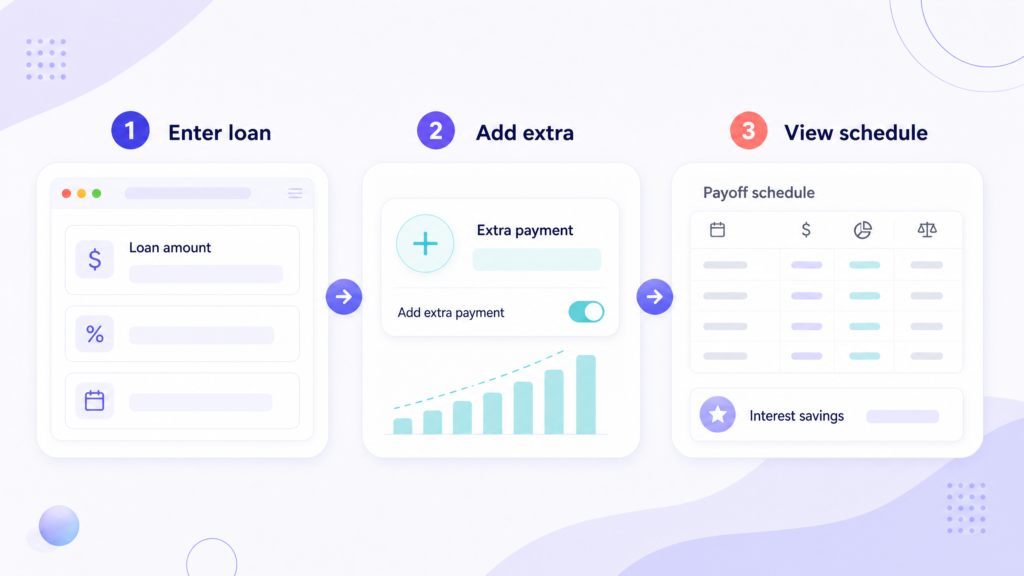
On that same $300,000 loan, an extra $200 a month cuts about seven years off the term and saves roughly $103,000 in interest. An extra $500 clears it about twelve and a half years early. The calculator above shows the exact figures for your own loan, and this breakdown of extra payments covers when it is and is not the best use of the money.
How to read the schedule
The table groups payments by year so you can see the shape of the loan at a glance. Tap any year to expand it into individual months.
Two things are worth looking for. First, find the month where principal overtakes interest — that is the real halfway point of the loan, and it is much later than the calendar midpoint. Second, look at the balance after five years. On a 30-year loan, you will typically have paid off less than 8% of what you borrowed.
What this calculator does not include
The schedule covers principal and interest only. Your actual monthly payment will also include property tax, homeowners insurance, and PMI if your down payment was under 20% — together often adding 30% to 50% on top. For the full monthly figure, use the mortgage calculator with taxes and insurance.
It also assumes a fixed interest rate. If you have an adjustable-rate mortgage, the schedule is accurate only until your first rate reset.
Frequently asked questions
What is an amortization schedule? A table showing every payment over the life of a loan, split into principal and interest, with the remaining balance after each one.
Why is so much of my early payment interest? Interest is charged on the outstanding balance, which is highest at the start. As the balance falls, the interest portion shrinks and the principal portion grows.
Does paying extra reduce my monthly payment? No. It shortens the loan instead. Your required payment stays the same, but you finish earlier and pay far less interest. To lower the payment itself you would need to refinance or ask your lender about recasting.
When should I make extra payments? Earlier is dramatically better. An extra $10,000 in year one saves far more than the same $10,000 in year twenty, because it removes interest from all the years in between.
Are there penalties for paying early? Most modern mortgages have none, but some loans do. Check your loan documents before committing to a prepayment plan.
These figures are estimates for planning purposes. Your lender's schedule may differ slightly due to rounding, payment timing, and fees.
Related QTools calculators
Compare your loan scenarios with the Home Loan Calculator, estimate what price range fits your income with the House Affordability Calculator, or check percentage changes with the Percentage Calculator.